A hungry girl offered to play the piano for food, and what followed moved everyone to tears.
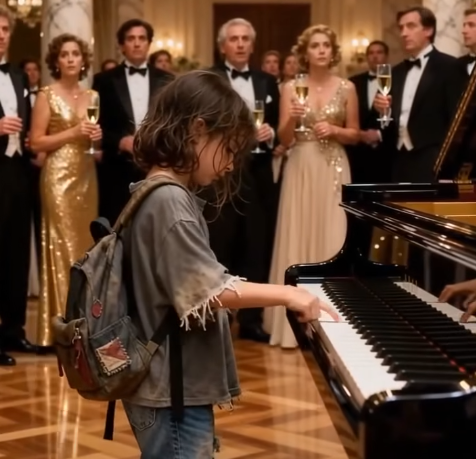
The ballroom shimmered beneath tiers of crystal chandeliers, their reflections scattered across marble floors and silk gowns. Laughter blended with the gentle rise and fall of a string quartet. It was the annual “Voices of Tomorrow” gala — an evening devoted to talent, charity, and expectation. Waiters slipped between gold-draped tables with champagne and caviar while guests congratulated themselves on their success.
Outside, the November cold cut sharply. On the steps stood a barefoot girl in a worn gray dress, arms wrapped around her thin frame. Her name was Lydia. Hunger gnawed at her, but her eyes weren’t drawn to the food or the glittering guests. They were fixed on the grand piano near the stage — a black Steinway so polished it caught every glint of light.
Not long ago, Lydia’s days had been filled with music. She had played for hours on the battered upright her mother had bought secondhand, their small apartment echoing with sound. Then illness arrived, followed by bills, then eviction. Her mother was gone now, and Lydia had learned to disappear — sleeping in shelters, keeping warm in stations, living on scraps. But the sight of that piano stirred something deep within her.
She wanted to play again.
Gathering her courage, she pushed open the heavy doors. Warmth washed over her. Conversations faltered. Faces turned. A guard stepped forward, but Lydia lifted her chin.
“Please,” she said. “May I play? One song — for a meal.”
A wave of surprise moved across the room. Some guests looked amused; others uneasy. The guard glanced toward the head table.
There sat Oliver Marchand, a world-famous pianist and the gala’s honored guest. He studied Lydia — her dirty hands, her trembling voice, and the unmistakable spark in her eyes.
“Let her play,” he said.
Silence followed. The crowd parted. Lydia walked toward the piano, aware of every watchful gaze. Her fingers hovered above the keys. For a moment, she froze — not from fear, but from memory. Then she pressed down a single note.
It was soft, uncertain. But the melody grew. Fragile, then swelling. Imperfect, yet deeply human. Every chord carried her story — hunger, loss, lonely nights. Beneath the sorrow lived a glint of hope.
The chatter died. Glasses stilled. Even the servers stopped moving. Her music filled the vast ballroom, reaching hearts dulled by comfort.
Lydia played as though this moment were the only one that had ever mattered. Her thin fingers moved with unexpected strength, shaping a melody that felt both delicate and fierce.
When the final tone faded, the silence held. Then one person began to clap. Another joined. Soon the room thundered with applause.
She had asked for a meal, but she had given them something far greater.
Oliver approached. “Your name?” he asked.
“Lydia.”
“Well, Lydia,” he said, “you won’t have to play for food anymore.” A plate was brought to her — not as charity, but as acknowledgment. Then he addressed the room. “Tonight, we witnessed something real. Music isn’t born from ease. It’s born from the soul. Lydia reminded us of that.”
Applause rose again. Some guests wiped their eyes. Others offered help. Lydia barely heard them. For the first time in years, she felt visible.
She ate her first proper meal in weeks that night. But the fullness she felt came from something deeper than food.
After the gala, Oliver handed her a folded napkin with an address. “Come tomorrow,” he said. “It’s a conservatory I support. We’ll arrange lessons, housing, and — if you choose — a future.”
“Why?” she asked.
“Because once, I played on the street for bread. Someone lifted me up. Now it’s my turn.”
Lydia didn’t sleep that night. Lying on a shelter cot, she watched the city lights and traced invisible keys in the air. At dawn, she walked to the address: the Marchand Academy of Music.
She hesitated, wondering if she’d imagined everything. But inside, a woman greeted her. “We’ve been expecting you. Your piano is ready.”
Months passed. Lydia practiced tirelessly. Her hands still shook the first day, but now her notes carried gratitude instead of desperation. Her progress was swift.
Oliver visited often. “Technique matters,” he said, “but heart matters more. Never lose what made that ballroom fall silent.”
Years went by. Lydia became a prodigy. Her name appeared in newspapers. Concert halls filled with people who remembered the barefoot girl who had once played for food.
When she returned to that same ballroom, the chandeliers glowed as before. She wore a simple blue gown now. The audience held still as she played the same piece — richer, steadier, full of certainty.
The applause that followed was overwhelming. Oliver, older and slower, watched with quiet pride.
Afterward, a young boy approached, clutching an envelope. “Miss Lydia,” he said. “I don’t have much… but could you teach me someday?”
She knelt. “You don’t need much,” she said. “Only a song inside you.”
Walking home under the cold November sky, Lydia thought of the girl who had once played for food — and realized her hunger had never been for bread.
It had always been for music, for possibility, for a voice.
And now, she had one.