Little Girl Gives Biker a Note: “He’s Not My Daddy, Please Help”
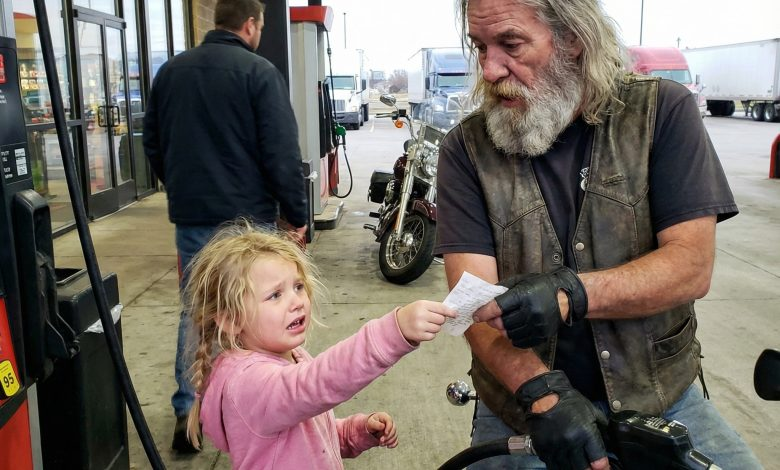
A little girl slipped a note into my hand while I was filling up at a truck stop off Route 41. It read, “He’s not my daddy. Please help.”
She couldn’t have been more than six—blonde pigtails, pink sneakers, and eyes far too old for a child her size.
The man holding her hand was inside buying cigarettes. She’d broken away just long enough to reach me, pressed the crumpled paper into my palm, then ran back before he noticed.
I looked down. Crayon on the back of a gas station receipt. The handwriting shook, but the message was unmistakable:
“He’s not my daddy. Please help. My real mommy is Sarah. He took me from the park.”
My blood went cold.
I’m sixty‑three years old. Spent forty years riding motorcycles. I’ve seen war, violence, and loss—Vietnam, bar fights, brothers dying on the road. None of it prepared me for that moment.
Through the station window, I saw him still paying at the counter. The girl stood beside him, her tiny hand locked in his grip. She was looking straight at me. Begging.
I had maybe thirty seconds to decide.
If I was wrong—if this was a misunderstanding or a custody issue—I could devastate an innocent family. But if I was right and stayed silent, that child could vanish forever.
I reread the note.
“He took me from the park.”
That wasn’t custody language.
That was abduction.
I quietly dialed 911 as I walked toward my bike.
“I’m at the Pilot truck stop on Route 41 South, mile marker 87. I believe a child is being kidnapped. White male, around forty, brown hair, green jacket, jeans. He’s with a blonde girl, about five or six. She gave me a note saying he took her.”
The dispatcher’s tone sharpened.
“Do not approach. Officers are on the way. Can you keep visual contact?”
“I’ll do my best.”
The man exited the store, dragging the girl behind him. He headed for a white van parked at the edge of the lot. No rear windows. My stomach dropped.
“White van,” I said. “North end of the lot. No back windows. He’s moving now.”
“Units are four minutes out. Do not engage.”
Four minutes felt like an eternity. In that time, the van could be gone. She could be gone.
He slid the side door open and started lifting her inside.
She screamed.
Not a tantrum. Not frustration. Pure terror—the kind that comes from deep inside and tells you something is terribly wrong.
I couldn’t wait anymore.
“Hey!” I shouted as I walked toward them. “Hold up a second!”
He froze. His eyes locked onto mine—cold, calculating.
“What do you want?” he asked flatly.
“Looks like your front tire’s low,” I said, pointing. “Might want to check it before hitting the highway.”
He glanced. The tire was fine. We both knew it.
“It’s fine. Mind your business.”
The girl struggled in his arms. “I want my mommy! I want my real mommy!”
“She’s throwing a fit,” he said quickly. “Divorced parents.”
I stepped closer. “What’s your daughter’s name?”
A hesitation. Just a fraction of a second.
“Emma.”
I looked at her. “Is your name Emma?”
She shook her head violently. “No! I’m Lily! He’s lying!”
The man’s expression changed. The mask slipped. Something empty stared back at me.
“Back off, old man.”
“I don’t think so.” I positioned myself in front of the van door. “I think you’re going to put her down.”
“Or what?”
I heard engines. Three motorcycles pulling in—my brothers from the club. We were supposed to meet here before a charity ride. They saw the situation and shut their bikes down immediately.
“Or you’ll have a bigger problem than you planned for,” I said.
He looked at them. Big men. Leather vests. No hesitation in their steps.
He panicked.
He dropped Lily and ran.
I caught her before she hit the ground, holding her as my brothers took off after him. She clung to my neck, sobbing.
“You’re safe,” I whispered. “You’re safe now.”
They tackled him before he made it fifty feet. By the time police arrived minutes later, he was pinned to the pavement.
I sat on the curb with Lily in my arms. She was shaking.
“What’s your mommy’s name?” I asked gently.
“Sarah Mitchell. Maple Street. He took me from the playground yesterday.”
Yesterday.
The officer nearby froze. Her radio crackled moments later.
“Amber Alert confirmed. Lily Mitchell, age six.”
Pink sneakers. Just like the alert.
“We found her,” the officer said, voice thick. “Notify the mother.”
Lily looked up at me. “Can you stay until my mommy comes?”
“I’m not going anywhere.”
We waited. She told me everything—how he grabbed her, how she stayed quiet to protect her mom, how she hid paper in her shoe and planned her escape.
At six years old, she had planned her own rescue.
Then I heard it—screaming.
A woman running across the lot.
“LILY!”
The girl leapt from my arms. Her mother collapsed to her knees, holding her like she’d never let go.
“You saved her?” the woman asked me through tears.
“Your daughter saved herself,” I said. “I just listened.”
She hugged me, sobbing. “Thank you.”
Later, I learned the truth. The man was a registered offender. Three other children before Lily. None found.
Lily was supposed to be the fourth.
I think about those thirty seconds often. About how close it was. About what happens when people look away.
Lily is eight now. She writes me letters. Sends drawings. Keeps a dog named Biker.
Her last card sits on my refrigerator.
“Thank you for being brave when I needed you.”
I’m not a hero. I was just someone who paid attention.
Sometimes, that’s all it takes.
To anyone reading this: trust your instincts. Watch the people around you.
If something feels wrong, it probably is.
You might be the only thing standing between a child and something unthinkable.
Don’t look away.